How Does Meesho Make Money? Revenue Model Explained (2026)
By Javed, founder of Javedify, a Mumbai agency that manages Meesho, Amazon and Flipkart seller accounts. Last updated October 2026.
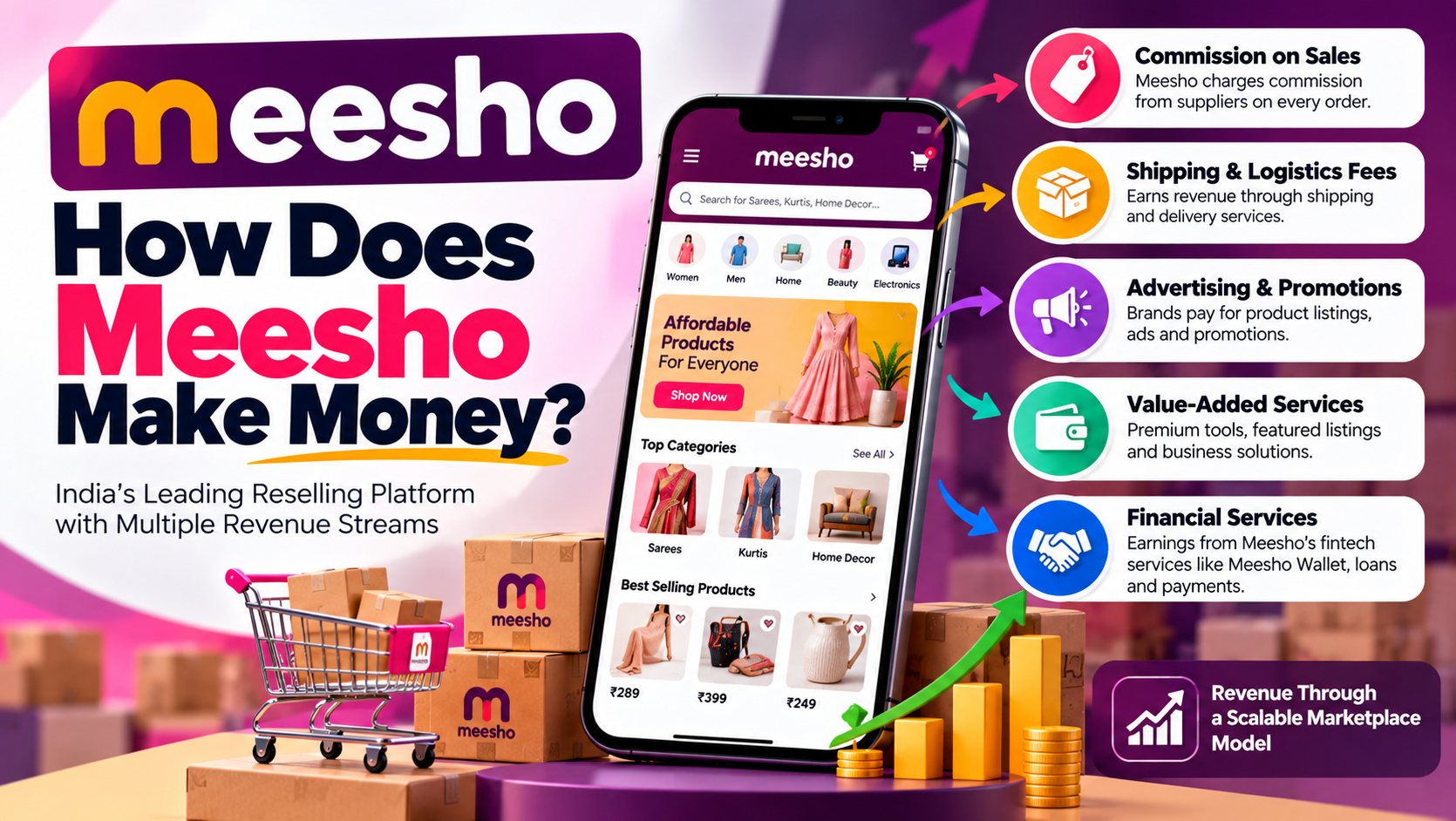
Meesho makes money from seller-side services, not from a commission on each sale. Sellers on most categories pay 0% commission. Meesho earns from four main things:
- Logistics and shipping fees charged to sellers, including through its own logistics network, Valmo (about 1.5% of net merchandise value in Q1 FY27, per Business Standard).
- Advertising that sellers and brands pay for to get more visibility (about 3% of net merchandise value in Q1 FY27, per the same report).
- Content commerce fees for working with creators who promote products.
- New businesses such as Meesho Mall for brands, AI services and financial services, which are still small.
Meesho does not publish how its revenue splits between these streams, so exact shares are analyst estimates. This guide covers each stream, how big Meesho is, whether it is profitable, how its model differs from Amazon and Flipkart, and what it means for you if you sell on it. Figures were checked in October 2026 against MediaNama, Inc42, Feedough and Business Standard.
How Meesho Works in Simple Words
Meesho is an online marketplace in India that connects sellers with buyers. Sellers list products, buyers order, and Meesho runs the app, handles payments and, for many orders, the delivery. Business Standard reports about 274 million annual transacting users, 2.8 billion orders placed and an average order value of around ₹265, with almost 90% of users outside the top 8 cities. That is a very large number of small orders, which is why small fees add up.
How Does Meesho Make Money? The Revenue Streams
Revenue streamWho paysHow it worksLogistics and fulfilment (Valmo)SellersShipping charges based on weight, delivery zone and payment mode, plus return shipping chargesAdvertisingSellers and brandsPaid promotion for higher visibility in search and category pages, on a cost-per-click basisContent commerce feesSellersFees to work with creators who promote products through videos and live shoppingMeesho MallBrandsA storefront for branded products, where brands spend more on visibilityNew initiativesSellers and othersAI services, digital financial services and hyperlocal logistics, still very small
1. Shipping and Logistics Fees
When an order is delivered, the seller is charged a shipping fee that depends on the product weight, the delivery zone and the payment mode. When a product is returned, a return shipping fee can be charged. Business Standard puts logistics income at about 1.5% of net merchandise value in Q1 FY27. Feedough says Valmo handled about 50% of Meesho shipments in recent quarters, down from a peak of 60% in mid-2025. Inc42 questions whether logistics is a real profit pool or mainly cost recovery, because Meesho does not report a separate figure.
2. Advertising
Sellers can pay to appear higher in search results and recommendations. Business Standard puts ad revenue at about 3% of net merchandise value in Q1 FY27, and Feedough reports that seller ad budgets more than doubled in FY26. Advertising is optional for sellers, which is why it is a flexible but uncertain income source for Meesho.
3. Content Commerce
Creators post videos and live shopping content to promote products, and sellers pay fees to work with them. Inc42 notes that creator payments are booked as advertising and sales promotion expenses, not as revenue, and Feedough calls this stream early-stage.
4. Meesho Mall and Other New Businesses
Meesho Mall hosts branded products, and Feedough says it has over 1,200 brands. Other new businesses, including AI services, digital financial services (a share of interest income on seller credit) and hyperlocal logistics, contributed just ₹12.7 crore in FY26, according to Inc42. These are bets for the future, not the main earner today.
A Simple Example: What Meesho Earns on One Order
This is an average illustration, not a real order. Using the average order value of about ₹265 and the Q1 FY27 shares reported by Business Standard:
ItemShare of order valueOn a ₹265 order (approx.)Logistics incomeabout 1.5%about ₹4Ad revenueabout 3%about ₹8Total from these two streamsabout 4.5%about ₹12
Meesho still has to pay for its own logistics, technology, payments, marketing and staff out of this, which is why it is still loss-making at the company level. Your own costs as a seller are different, because they depend on your product, weight, zone and returns.
What "Zero Commission" Really Means
Zero commission means Meesho does not take a percentage of the sale price on most categories. It does not mean selling is free of cost. Sellers still pay shipping charges, return charges and optional ad costs, and some restricted categories may have charges. For a seller, your real costs are shipping, returns and ads, not commission.
Meesho vs Amazon vs Flipkart: How Their Models Differ
PointMeeshoAmazon and FlipkartCommission on sales0% on most categoriesSellers typically pay a commission or referral fee that varies by categoryMain income from sellersShipping and logistics, ads, other servicesCommission, fees for shipping and fulfilment, ads and moreTypical productsValue-priced products, strong in fashion and homeWide range, including electronics and branded goodsWhere to check exact chargesSupplier panel fee calculatorSeller Central or the Flipkart Seller Hub fee pages
Fee structures change often, so check each platform's current fee page before you compare costs. Our Amazon, Flipkart and Meesho account management services cover all three.
How Big Is Meesho? Revenue, Loss and Listing
NumberFigureSourceRevenue from operations, FY25₹9,390 crore (Rs 9,389.90 crore)MediaNamaRevenue from operations, FY26₹12,626 crore, up 34.5%MediaNamaNet loss, Q4 FY26₹166 crore, down from ₹1,391 crore a year earlierMediaNamaRevenue, Q1 FY27₹3,713 crore, up 48.3%Feedough (not verified against primary sources)Net loss, Q1 FY27₹132.8 croreFeedough (not verified against primary sources)Gross merchandise value, FY26₹70,710 croreFeedough (not verified against primary sources)Contribution margin, Q1 FY274.6%Business Standard
In simple words, revenue is growing fast and losses are shrinking, but Meesho was still loss-making at its latest reported quarters. Inc42 reports the marketplace segment gave 99.9% of operating revenue in FY26. Gross merchandise value is the total value of goods sold on the platform, and it is not the same as Meesho's own revenue. Meesho shares were listed on the BSE and NSE on 10 December 2025 at an issue price of ₹111 (Angel One). This is not investment advice, and you should read Meesho's own filings for current numbers.
Why Does Meesho Offer Zero Commission?
- To attract many sellers. More sellers means more products and lower prices for buyers.
- To grow the number of orders. Meesho earns from services on each order, so volume matters.
- To earn from optional services. Logistics and ads give revenue without a commission.
Risks in Meesho's Business Model
- Sellers can skip paid services. Inc42 notes that sellers need not use Meesho's logistics or ads, which could put profit per order at risk.
- Strong competition. Business Standard says Meesho faces strong and rising competition from Amazon and Flipkart in value commerce.
- Dependence on third-party logistics and limited control over product quality are listed as company-specific risks in the same report.
- Thin margins. The contribution margin was 4.6% in Q1 FY27, so small changes in costs matter.
What Meesho's Business Model Means for Sellers
- Watch your shipping charges. This is where the platform earns, and wrong weight or zone charges can cut into your profit.
- Count returns before you price. Return shipping is charged, and fashion returns can be high.
- Use ads only when your listings are ready. Ads are optional, and they cost money.
- Do not depend on Meesho alone. The marketplace owns the customer relationship, so build your own brand.
- Check your panel often. Fees and rules change during the year.
If you are new, read our guides on how to become seller on Meesho, Meesho seller registration, how to sell on Meesho and how to start business on Meesho.
Need Help Managing Your Meesho Seller Account?
Shipping charge checks, claims, listings and keywords need steady work every week, and this is where many sellers lose money without noticing. Javedify's Meesho account management costs ₹2,900 a month for up to 100 new SKUs, with keyword updates, claim filing and shipping charge reduction. Promotions and ads run only if you approve them, and we cannot promise a number of orders. See also our Amazon and Flipkart account management services.
Free Meesho Account Audit
Worried about shipping charges, returns or low orders? Email info@javedify.com with your supplier name and your main problem, and ask for a free Meesho account audit. We will review your supplier account and tell you what to fix first. There is no obligation to hire us.
Want Your Own Online Store Too?
Many sellers add their own website, to keep their brand and customer list. Javedify's website packages start from ₹9,999. Book a free consultation. Javed sits with you and explains the price, the features and the best option for your business, free, with no pressure to buy, even if you never hire us. See our ecommerce website development service.
How Does Meesho Make Money: Frequently Asked Questions
How does Meesho make money with zero commission?
It earns from shipping and logistics fees, paid advertising, content commerce fees and small new businesses, not from a commission on each sale.
Does Meesho charge sellers?
Registration is free and most categories have 0% commission, but sellers pay shipping and return charges, and optional ads. Some restricted categories may have charges.
How much does Meesho earn from ads?
Business Standard puts ad revenue at about 3% of net merchandise value in Q1 FY27. Meesho does not report an exact ad revenue figure.
What is Valmo?
Valmo is Meesho's in-house logistics network. Feedough says it handled about 50% of Meesho shipments in recent quarters.
What is Meesho's main source of revenue?
Meesho reports almost all revenue under its marketplace segment (99.9% in FY26, per Inc42) and does not publish the split between logistics, ads and other services.
How much revenue does Meesho make?
MediaNama reports revenue from operations of about ₹12,626 crore in FY26, up 34.5% from ₹9,390 crore in FY25.
Is Meesho profitable?
At its Q4 FY26 results it still reported a net loss of about ₹166 crore, much lower than a year earlier. Feedough reports a loss of ₹132.8 crore in Q1 FY27. Check the latest quarterly results for current numbers.
Is Meesho a listed company?
Yes. Meesho shares were listed on the BSE and NSE on 10 December 2025, according to Angel One.
Is Meesho better than Amazon or Flipkart for sellers?
It depends on your product. Meesho has 0% commission on most categories but charges for shipping and ads, and Amazon and Flipkart typically charge commission by category. Compare the total cost per order on each platform before you choose.
How can sellers reduce Meesho shipping charges?
Check weight and dimensions on each listing, review charges for wrong deductions, and file claims where needed. Our Meesho account management includes shipping charge reduction.
Get Help with Your Meesho Account from Javedify
Email info@javedify.com for a free Meesho account audit, message us on WhatsApp, call +91 89284 87610 or book a free consultation. Visit javedify.com to see all our services.
Sources
- MediaNama: Meesho posts Rs 166 crore loss in Q4 FY26, revenue jumps 47%
- Inc42: Decoding Meesho's zero-commission model and seller-centric revenue engine
- Feedough: Meesho business model, how does Meesho make money
- Business Standard: Rising competition, premium valuations likely to cap gains in Meesho
- Angel One: Meesho share price jumps over 54% on listing day