Real Estate Website Development: Cost, Features and Leads (2026 Guide)
By Javed, founder of Javedify, a web design and development company in Mumbai. Last updated November 2026.
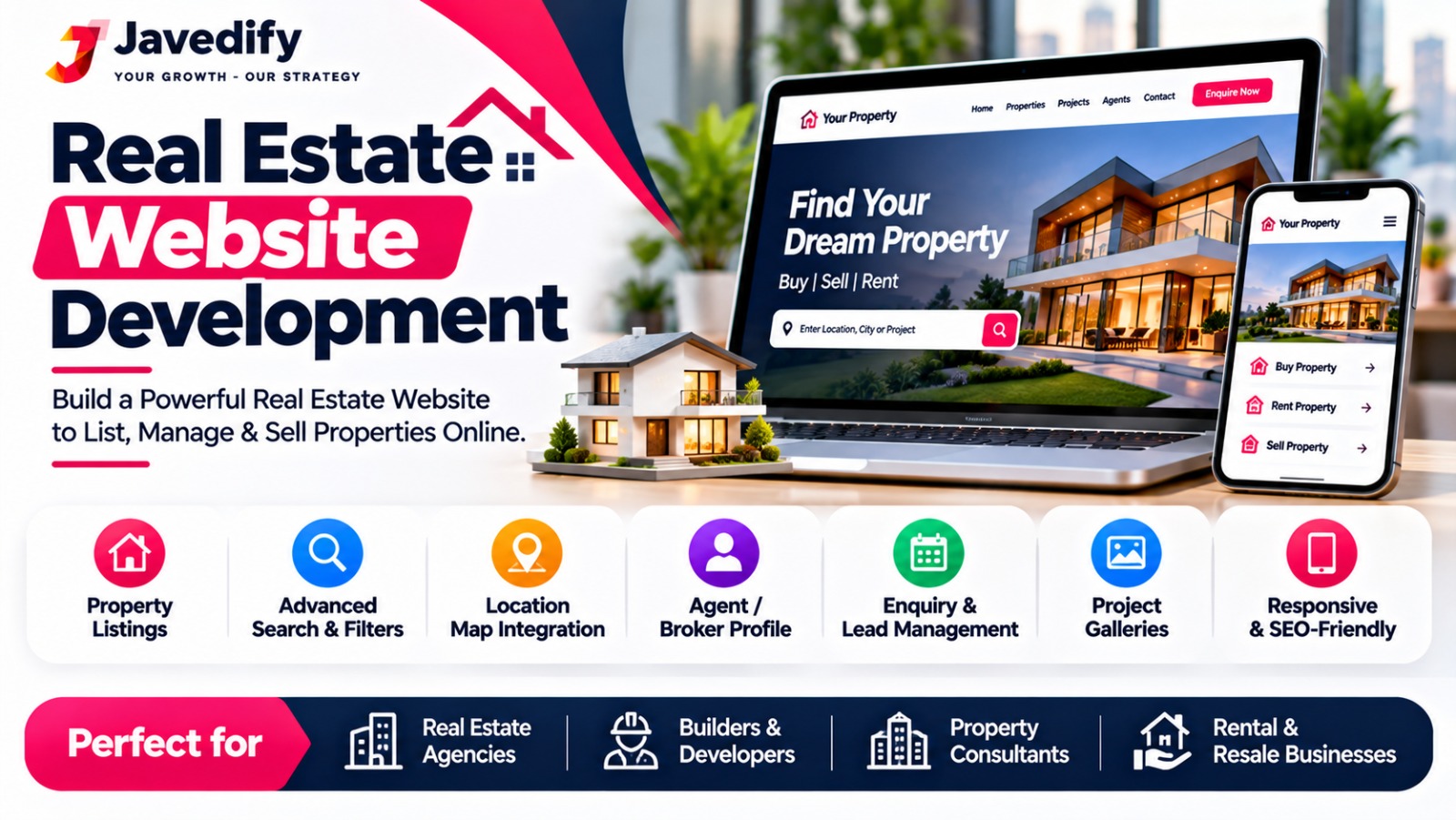
Real estate website development is the work of building a website for a builder, broker or agent that shows projects and properties, answers a buyer's questions and turns visitors into enquiries. A good real estate website has clear project or property pages, search filters, photos and floor plans, maps, a WhatsApp and call button on every page, RERA details, and a fast mobile layout. In India, prices run from about ₹10,000 for a single-project page to ₹3,00,000 or more for a portal with a CRM, and Javedify's website packages start from ₹9,999.
This guide explains real estate website development for builders, brokers and property agents: the types of real estate websites, the features that bring leads, what MahaRERA says about showing registration details, how much a real estate website costs, how long it takes, and the mistakes that waste money. If you depend only on property portals today, this will show what your own website can add. Details were checked in November 2026 against several agency guides and news reports.
Real Estate Website Development: Key Points in Short
- Purpose: show your projects or listings and turn visitors into leads that you own.
- Must-haves: property or project pages, filters, photos, maps, enquiry forms, WhatsApp and call buttons.
- Trust: RERA registration details, approvals and clear information.
- Mobile: most buyers browse on phones, so speed and a clean phone layout matter most.
- Cost: from about ₹10,000 for a project page to ₹3,00,000+ for a portal. Javedify starts from ₹9,999.
Why a Real Estate Business Needs Its Own Website
Property portals bring buyers, but you pay for listings and you compete with other sellers on the same page. SparkCanvas says portal leads are shared with 5 to 10 competing agents. That is one agency's claim, so check your own numbers, but the point is clear: a website you own keeps your leads, your brand and your project story in one place. Sionex says agents without a strong website become invisible when buyers search, and that leads kept in WhatsApp chats and notebooks slip away without a simple CRM.
- You own the leads. Every enquiry comes to you, not a shared pool.
- You build trust. A clear project page with RERA details, photos and approvals reassures buyers.
- You can be found on Google. Local searches such as "3 BHK flats for sale in [area]" can bring buyers who are already searching.
- You control the message. Your offers, videos and updates stay in your own words.
Types of Real Estate Websites and Their Cost
TypeBest forTypical market priceTypical deliverySingle-project landing pageOne launch or one project₹9,999 – ₹14,999 (SparkCanvas)3 to 5 daysAgent or small firm websiteBrokers and agents with listings and lead capture₹19,999 – ₹49,999 (SparkCanvas) or ₹40,000 – ₹1,00,000 (Sionex)7 to 14 daysBuilder website with several projectsDevelopers showing their projects and track record₹1,00,000 – ₹3,00,000 (Sionex)Varies with the projectPortal with admin and CRMManaging many listings and leads₹49,999 – ₹1,20,000+ (SparkCanvas) or ₹3,00,000+ (Sionex)3 to 6 weeks
Prices from SparkCanvas (June 2026) and Sionex (June 2026). Both sell website services, and their ranges differ a lot, so use them only as a rough guide and ask for a written quote. Javedify websites start from ₹9,999. For a website with property listings, filters, an admin panel or CRM links, book a free consultation for your exact price.
Real Estate Website Features That Bring Leads
FeatureWhy it mattersProject or property pagesOne clear page for each project or listing, with price, location, size and statusSearch and filtersBuyers filter by BHK, budget, area, property type and project statusPhotos, floor plans and videosBuyers decide faster when they can see the home. Some sites add 360-degree tours and construction progress videos.Maps and nearby placesA Google Maps pin with schools, metro stations, hospitals and highways nearbyWhatsApp and call buttonsOne tap to ask about a property, on every pageEnquiry and site visit formsShort forms that collect name, phone, budget and preferred visit timeEMI calculatorHelps buyers understand the monthly payment, and keeps them on your pageBrochure downloadGives a reason to share a phone numberRERA details and approvalsBuilds trust and supports complianceFast, mobile-friendly designMost buyers browse on phones
Features follow SparkCanvas and Sionex. You do not need all of them on day one. A project page with strong photos, a clear price signal, a map, a WhatsApp button and a short form can already generate leads.
Lead Capture Ideas That Work for Property
- A "Chat on WhatsApp for Price Sheet" button, with the property name filled in so you know which project the buyer means.
- A brochure download that asks for a phone number.
- A site visit booking form with a date and time.
- Enquiry alerts sent to your phone or sales desk, so no lead waits.
- A simple CRM or a sheet where every enquiry is tracked, assigned and followed up.
RERA and Your Real Estate Website: What to Show
In Maharashtra, MahaRERA's April 2025 notification says developers and agents must show the project's registration number and a QR code in all advertising, including print, digital, hoardings, brochures and social media. The registration number must be shown in a font at least as large as the largest font used for contact details or addresses, and violations can bring penalties of up to ₹50,000, with a 10-day window to correct the problem after it is detected. This is reported by The Realty Today.
The report does not specifically address websites beyond digital ads, so ask your lawyer or check your state RERA authority's website for the exact rule that applies to your site. Other states have their own RERA rules. Practical steps for any real estate website:
- Show the RERA registration number of each project clearly on its page.
- Link to the project's page on the official RERA website where your state asks for it.
- Show approvals and legal documents if you are allowed to share them.
- Do not publish claims about returns, possession dates or approvals that you cannot prove.
This is general information, not legal advice.
Mobile Speed and Design for Property Buyers
SparkCanvas says over 80% of property buyers browse on smartphones, and that image-heavy sites on some platforms can take 5 to 8 seconds to load on mobile. Both are one agency's claims, but the lesson holds for any real estate site: use compressed images, keep the first screen simple, and test on a real phone. See our guide on responsive website development.
How to Get Found on Google for Property Searches
- One page for each project or area. Do not put everything on one page.
- Use local words. Buyers search for phrases such as "3 BHK flats for sale in [area]" or "plots in [area]". Write them naturally in titles, headings and text.
- Add useful content. Area guides, how to buy, documents needed and FAQs give buyers reasons to stay.
- Claim your Google Business Profile with the right address and phone, and ask happy clients for reviews.
- Keep pages fast and mobile-friendly.
- Set up Google Analytics and Search Console to see which pages bring enquiries.
SEO takes months. WebFX says it takes on average three to six months to show results. See our guide on SEO services in Mumbai price for how SEO plans work.
Real Estate Website Development Process and Timeline
- Plan. Decide your projects, your buyers, the pages and the lead flow.
- Collect content. Photos, floor plans, brochures, RERA details, price signals and location details.
- Design. The look and the layout of the home page, project pages and forms.
- Build. Create the pages, filters, forms, maps, WhatsApp buttons and admin area.
- Connect lead alerts. Send each enquiry to your phone, email or CRM.
- Test. Check phones, speed, forms and links.
- Launch and improve. Track enquiries and update projects.
SparkCanvas quotes 3 to 5 days for a single-project page, 7 to 14 days for a full agency or builder website, and 3 to 6 weeks for a portal. Your timeline depends mostly on how fast you send content and approve designs. Read our guide on the website development timeline.
What Affects the Cost of a Real Estate Website?
- Number of projects and listings. More pages and more data take more work.
- Search and filters. Dynamic property search costs more than a simple project page.
- Admin panel. If you want to add and edit listings yourself, you need a panel.
- CRM and WhatsApp integration. Sending leads to a CRM adds setup work.
- Custom design. A design built around your brand costs more than a template.
- Content and media. Professional photos, videos and 3D tours cost extra.
After launch you also pay for the domain, hosting and maintenance. Read our guide on how much does a website cost for a full breakdown of yearly costs.
Common Mistakes in Real Estate Websites
- Depending only on property portals and sharing leads with other sellers
- No RERA details or unclear project information
- Slow, image-heavy pages that load badly on phones
- No WhatsApp or call button on property pages
- Long enquiry forms that people do not finish
- Leads kept in chats and notebooks instead of a simple tracker
- Out-of-date prices and sold-out units still shown
- No Google Analytics or Search Console, so you cannot see what works
Get a Real Estate Website from Javedify
Javedify builds websites for businesses that want enquiries, with websites from ₹9,999 and custom builds with admin panels, call and WhatsApp buttons. Tell us your projects or listings, and we will explain what you need, what it costs and how long it takes. Book a free consultation. Javed sits with you and explains the price, the features and the best option for your business, free, with no pressure to buy, even if you never hire us. You can also email info@javedify.com, message us on WhatsApp or call +91 89284 87610. See our website development service, our SEO services and our portfolio.
Real Estate Website Development: Frequently Asked Questions
What is real estate website development?
It is building a website for a builder, broker or agent that shows projects or properties and captures buyer enquiries, with features such as listing pages, filters, maps, WhatsApp buttons and lead forms.
How much does a real estate website cost?
Market guides show about ₹9,999 to ₹14,999 for a single-project page, ₹19,999 to ₹1,00,000 for an agent or small firm site, ₹1,00,000 to ₹3,00,000 for a builder website and ₹3,00,000 or more for a portal with CRM. Javedify's websites start from ₹9,999, and a free consultation gives your exact price.
How long does it take to build a real estate website?
SparkCanvas quotes 3 to 5 days for a single-project page, 7 to 14 days for a full website and 3 to 6 weeks for a portal. It depends on your content and approvals.
What features should a real estate website have?
Project or property pages, search filters, photos and floor plans, maps, WhatsApp and call buttons, enquiry forms, RERA details and a fast mobile layout.
Do I need a website if I list on property portals?
Yes. A website lets you keep your leads, build your own brand and be found on Google, instead of sharing the same buyer with many other sellers.
Should a builder website show the RERA number?
Yes. MahaRERA requires the registration number and a QR code in advertising, including digital ads. Check with your lawyer or your state RERA authority for the exact rule for your website.
Is a landing page enough for a new project?
For a single new project, a good landing page with photos, price signal, a map, a WhatsApp button and a short form can be enough to start. Add more pages as you grow.
Can buyers book a site visit on the website?
Yes. You can add a site visit form where buyers pick a date and time, and you receive the request instantly.
Can I update properties myself?
Yes, if the website has an admin panel. Ask for one if you plan to add or remove listings often.
How can a real estate website get leads from Google?
Build one page for each project or area, use local search words in titles and text, keep pages fast, claim your Google Business Profile and track results in Search Console. SEO takes months.
Can the website connect to a CRM?
Yes. Enquiries can be sent to a CRM, email, a sheet or WhatsApp. Tell us your setup in a free consultation.
What does Javedify offer for real estate websites?
We build business and custom websites with features such as enquiry forms, call and WhatsApp buttons, and admin panels. Book a free consultation to explain your projects and we will tell you the best option.
Start Your Real Estate Website with Javedify
Email info@javedify.com, message us on WhatsApp, call +91 89284 87610 or book a free consultation. Visit javedify.com to see all our services.