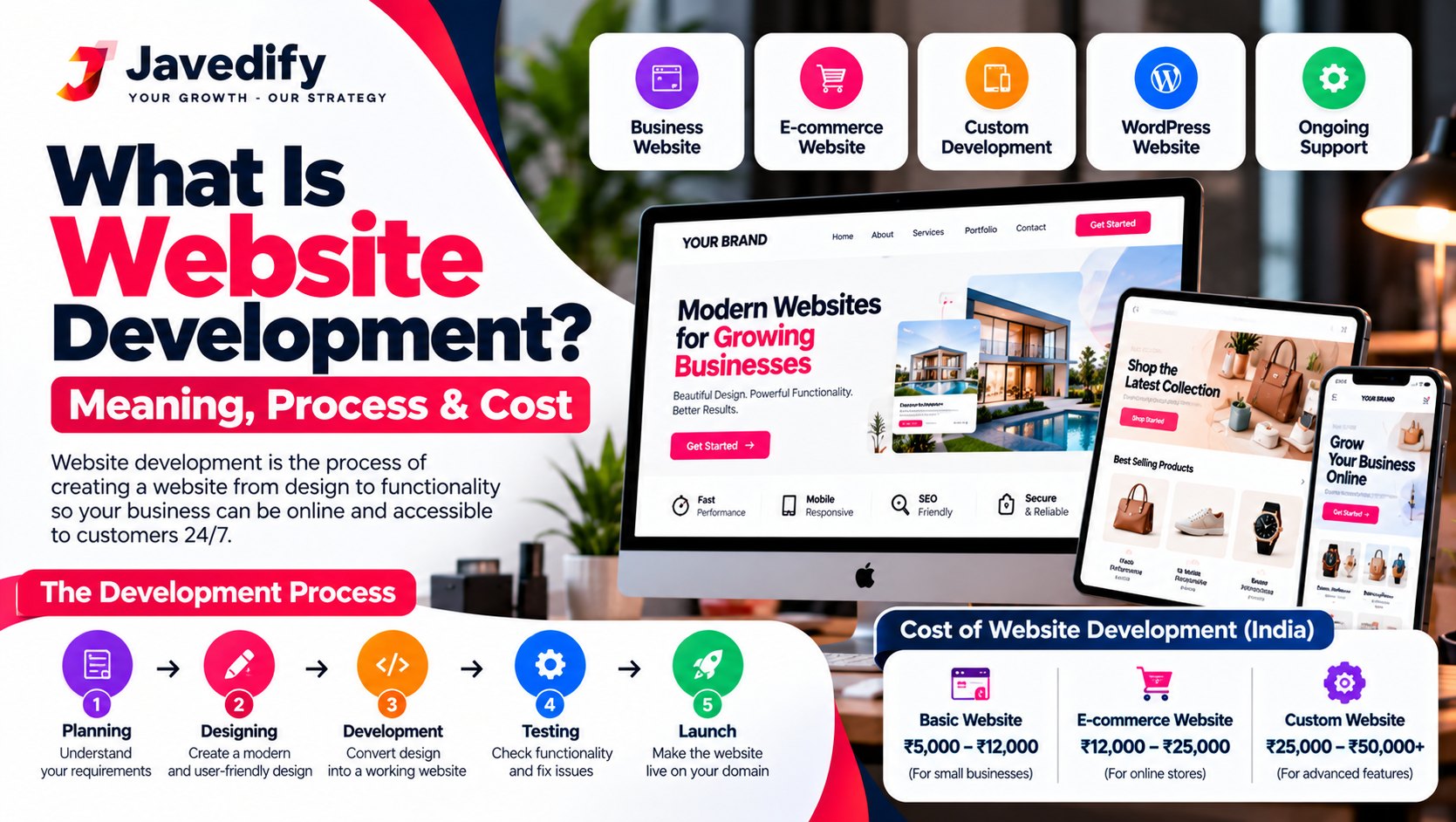
What Is Website Development? Meaning, Process, Types and Cost (2026 Guide)
By Javed, founder of Javedify, a web design and development company in Mumbai. Last updated October 2026.
Website development is the process of building and maintaining a website: planning it, designing it, writing the code that makes it work, testing it, putting it online and keeping it updated. It covers everything from a simple five-page business site to an online store with payments, a customer login and an admin panel. At Javedify, website packages start from ₹9,999.
This guide explains what website development is in plain words, with no technical background needed. You will learn what developers actually do, the difference between front-end and back-end, how website development differs from website design, the main types of websites, the steps in a real project, which technologies are used, and what it costs. If you plan to build a website for your business, this will help you ask the right questions and avoid paying for things you do not need. Prices in this guide were checked in October 2026.
What Is Website Development? Key Points in Short
- Meaning: building and maintaining a website so it works properly for visitors.
- Two sides: the front end (what visitors see) and the back end (the server, database and logic behind it).
- Main steps: planning, design, building, testing, launch and maintenance.
- Ways to build: a no-code website builder, WordPress, or custom code by a developer or agency.
- Cost: from a few thousand rupees for a simple site to lakhs for a large online store, and Javedify packages start from ₹9,999.
What Is Website Development? A Simple Definition
The website development meaning is simple. Web development is commonly defined as "the process of building and maintaining websites and web applications." A website developer turns a design and a business plan into a working website that people can open in a browser, on a phone or a computer.
A simple way to think about it: if a website were a shop, the designer decides how the shop looks, and the developer builds the shop, installs the doors, the lights, the till and the stockroom, and keeps everything working every day.
What Does a Website Include? The Parts of a Website
PartWhat it isDomain nameYour website address, such as javedify.comHostingThe server space where your website files live, so visitors can open them onlinePages and navigationHome, About, Services, Contact and the menu that connects themDesignLayout, colours, fonts and imagesContentThe text, photos and videos on each pageForms and back endEnquiry forms, logins, payments and the database behind themSecurity (HTTPS)A secure connection that protects visitors' dataAnalytics and SEOTools to see visitors, and page titles and headings that help Google understand your pages
Wix lists hosting, a domain name, a homepage, design, content and navigation as the basic parts of a website, and Mailchimp adds HTTPS and analytics to its checklist. See the sources at the end.
Website Development vs Website Design
PointWebsite designWebsite developmentFocusHow the website looks and feelsHow the website works and runsExamplesLayout, colours, fonts, images, menusCode, forms, payments, databases, speed, securityResultA visual plan that guides visitorsA live, working websiteSkillsVisual design, user experienceProgramming, servers, databases
Most business projects need both. A good web design and development company, such as Javedify, does the design and the development together. See our website development service.
Front-End vs Back-End vs Full-Stack Development
Front-End Development
Front-end development covers the part of the website that visitors see and use: the layout, text, images, buttons, menus and interactive features. It makes sure the site looks right and works smoothly on every screen size.
Back-End Development
Back-end development is the hidden layer behind the pages. It includes the server, the database and the logic that processes data: saving an order, checking a login, sending an email or showing the right product. Visitors never see it, but the website cannot work without it.
Full-Stack Development
A full-stack developer works on both the front end and the back end, and the database as well. Small and mid-sized projects often use full-stack developers, because one person or one team can build the whole site.
Definitions follow WebFX's web development glossary and Le Wagon's guide to web development.
Who Does What? Types of Web Developers
RoleWhat they doFront-end developerBuilds the visible pages with HTML, CSS and JavaScriptBack-end developerBuilds the server, database and logicFull-stack developerWorks on both sidesWeb designerDesigns the layout and lookWordPress or CMS developerBuilds sites you can edit yourselfE-commerce developerBuilds online stores with products, cart and payments
Types of Website Development
- Business websites. Information websites with pages such as Home, About, Services and Contact, built to bring you enquiries.
- Ecommerce websites. Online stores with products, cart, checkout, payments and stock. See our ecommerce website development service.
- Custom websites and web apps. Sites with special features, logins, dashboards or tools that no ready-made template provides.
- CMS websites. Sites built on a content management system such as WordPress, so you can edit pages yourself.
- Landing pages. Single focused pages for ads and offers.
How Website Development Works: The 7 Steps
The website development process in a professional project usually follows these stages. Learning them helps you know what to expect and when.
- Planning and requirements. You explain your business, your customers and your goals. The developer lists the pages and features you need, and you agree the budget and the content.
- Design and prototype. A wireframe (a simple layout blueprint) and a sitemap (the list and structure of your pages) are made, often as screens you can review before any code is written.
- Front-end development. The design is turned into real pages using code.
- Back-end development. Forms, logins, databases, payments and the admin panel are built and connected.
- Content and setup. Your text, photos and products are added, and your domain and hosting are connected.
- Testing. Pages, buttons, forms and checkout are tested on different phones and browsers.
- Launch and maintenance. The website goes live and is kept updated, backed up and secure.
These stages follow the process described by Le Wagon: planning, design, development, testing, deployment and maintenance.
Website Launch Checklist
Before any website goes live, a good developer checks the following. Ask your developer to confirm each one.
- The website opens correctly on mobile and desktop.
- Pages load quickly, and images are not too heavy.
- HTTPS is on, so the site shows as secure.
- Forms, buttons, call and WhatsApp links work.
- Each page has its own title, description and one main heading.
- Privacy policy, terms and other legal pages are added where needed.
- Analytics and Google Search Console are set up.
- Backups are on, and domain and hosting renewal dates are noted.
These checks follow the launch tips in Mailchimp's website development guide.
Technologies Used in Website Development
TechnologyWhat it doesHTMLGives the page its structure: headings, paragraphs, links, imagesCSSControls colours, fonts, spacing and layoutJavaScriptAdds interaction, such as menus, sliders and live updatesPHP and other server languagesRun the back-end logic on the serverDatabases such as MySQLStore information like products, orders and usersWordPressA content management system for easy-to-edit websitesFrameworks such as Laravel and ReactReady-made building blocks that speed up custom developmentNext.jsA framework for building fast, modern websites
You do not need to learn these. Your developer chooses the right ones for your project, such as WordPress for an easy-to-edit site or Next.js for a fast custom website. If you want to know the cost of a WordPress site, read our guide on WordPress website development cost in India.
Ways to Build a Website: Website Builder, WordPress or Custom Development
OptionWho it suitsGood sideWatch out forNo-code website builderSimple sites you want to manage yourselfNo coding, hosting and security are handled for youLess control, and you build and maintain it yourselfWordPressBusiness sites, blogs and portfolios you want to editEasy to edit, huge choice of themes and pluginsNeeds regular updates, backups and security careCustom developmentSpecial features, logins, large stores or fast custom sitesFull control over design and featuresCosts more and takes longer
Wix says coding becomes necessary only when you need behaviour that a platform does not already offer, and that building from scratch means you also own hosting, security patches and maintenance. HubSpot says WordPress holds around 60.7% of the CMS market, citing W3Techs. Wix and HubSpot both sell website products, so compare their views with other sources.
What Does Website Development Cost?
The cost depends on the type of website, the number of pages, the features and who builds it. This table shows typical market prices next to Javedify's one-time package prices.
Type of websiteTypical market priceJavedifyBasic website (about 5 pages)₹5,000 – ₹50,000From ₹9,999Business website (5 to 10 pages)₹25,000 – ₹1,00,000Free consultation for exact priceEcommerce website₹50,000 – ₹3,00,000Free consultation for exact price
Market ranges: basic sites from Hostinger India, business and ecommerce sites from Codingclave. Both sell related services, and their ranges vary, so use them as a rough guide. After the build you also pay for your domain and hosting renewals and for maintenance. For more detail, see our guides on website design cost in Mumbai and the cost of e-commerce website development in India.
Why Website Development Needs Regular Maintenance
A website is not finished on launch day. Software gets new versions, plugins stop working together, and security problems are found. Maintenance means regular updates, backups, security checks and fixes. Read our guides on website maintenance services and WordPress maintenance services. Maintenance plans start at ₹399 a month for WordPress and ₹499 a month for other websites.
How to Choose a Website Development Company
- Ask to see live websites they built, and open them on your phone.
- Get the price, the pages, the features and the delivery time in writing.
- Confirm that your domain, hosting and website are in your name.
- Ask what support you get after launch and what it costs.
- Check that SEO basics, such as page titles, headings and speed, are part of the build.
- Avoid companies that promise guaranteed Google rankings or sales.
See live sites built by Javedify: Emporio Sports, a football jersey store, and Goldior Luxury, a perfume brand. More work is on our portfolio page.
Why Website Development Matters for a Business
- Visibility. Customers search on Google and phones before they call or visit, and a website lets them find you.
- Trust. A clear, working website shows you are a real business.
- Always open. Customers can read your services, prices, location and contact details at any hour.
- Leads. Enquiry forms, call buttons and WhatsApp links turn visitors into enquiries.
- Sales. An online store lets customers order and pay without visiting you.
If you also want to be found on Google, our SEO services help your website reach more customers.
Want to Learn Website Development Yourself?
If you want to learn, HubSpot's guide suggests this order: learn how websites work, then HTML, CSS and JavaScript, build small projects such as a portfolio or a landing page, learn Git for saving your work, and publish your site. You do not need a degree to start. Free resources include freeCodeCamp and MDN Web Docs. If you only need a website for your business, hiring a developer is faster.
Get Help with Website Development from Javedify
Not sure which type of website you need, or what it should cost? Book a free consultation with Javedify. Tell us about your business, and we will explain in plain words the price, the features and the best option for your budget. It is free, with no pressure to buy, and the advice is yours even if you do not hire us. Fill the free consultation form, email info@javedify.com, message us on WhatsApp or call +91 89284 87610. Our website packages start from ₹9,999.
What Is Website Development: Frequently Asked Questions
What is website development in simple words?
It is the work of building a website: planning it, designing it, writing the code, testing it, putting it online and keeping it updated.
What is the difference between website design and website development?
Design is how the website looks. Development is how it works. Design covers layout, colours and images, and development covers the code, forms, payments, databases and security.
What are the types of website development?
The main types are front-end, back-end and full-stack development. Other types include e-commerce development, CMS (such as WordPress) development, and mobile and app development.
Can I build a website without coding?
Yes. A no-code website builder or WordPress can handle hosting and setup, so you can design visually. Coding is needed when you want features the platform does not offer.
Is website development the same as web development?
People use the two terms for the same thing. Some writers use web development for websites and web apps together, and website development for building a particular site.
Which language is best for website development?
HTML, CSS and JavaScript are the core of every website. For the back end, common choices include PHP, Python, Node.js, Java and others, and the best one depends on the project.
What does a website developer do?
A website developer writes the code that makes a website work, connects it to a database and a server, tests it, puts it online and fixes problems.
What is front-end and back-end development?
Front-end is the part visitors see and use. Back-end is the hidden part that handles data, logins, orders and the server.
What are the steps of website development?
Planning, design, front-end development, back-end development, content setup, testing, and launch with maintenance.
How long does website development take?
Wix says a simple five-page site can take a few days to a couple of weeks, and large custom builds can take several months. The time depends on the number of pages and features, and on how fast you send content and approve designs. Our custom ecommerce website is delivered within 13 days from the token payment, once we receive your content.
How much does website development cost?
Public guides show about ₹5,000 to ₹50,000 for a basic site, ₹25,000 to ₹1,00,000 for a business site and ₹50,000 to ₹3,00,000 for an online store. Javedify's website packages start from ₹9,999.
Do I need to know coding to get a website built?
No. The developer handles the code. You only need to share your business details, logo, photos and text.
Is WordPress website development good for business?
Yes, for many business sites, blogs and portfolios. WordPress is easy to edit, but it needs regular updates and security care.
What happens after the website is built?
You still need hosting, domain renewal, backups, updates and security checks. Many businesses also add SEO to get found on Google.
Start Your Website Development with Javedify
Email info@javedify.com, message us on WhatsApp, call +91 89284 87610 or book a free consultation. Visit javedify.com to see all our services.
Sources
- WebFX: What is web development?
- Le Wagon: What is web development, a comprehensive guide
- HubSpot: Web development intro, a breakdown of the basics for beginners
- Wix: Website development for beginners
- Mailchimp: A guide to website development
- Hostinger: How much does a website cost in India in 2026?
- Codingclave: Website Development Cost in Mumbai 2026